
Independent Watchmakers Triumph in Historic New York Watch Auction

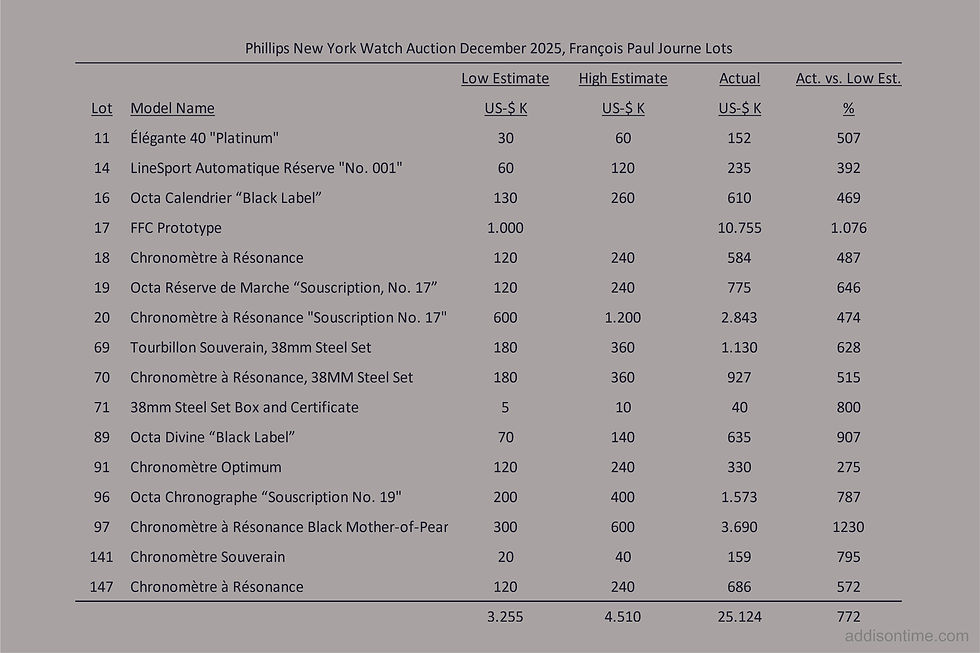
At year end, Phillips in Association with Bacs & Russo achieved an unprecedented $ 44 million in a momentous sale on their Park Avenue premises last weekend. In an overall soft collector’s market, this extraordinary result was driven by high end timepieces, created by key figures of the independent movement. 16 FP Journe and 2 Philippe Dufour lots accounted for 67% of the overall result alone, in a catalog made up of 147 lots in total. Here’s the story!

‘Independent Creative Horology’ is the code word for a group of independent watchmakers that started to challenge the traditional high-end players like Patek Philippe, Vacheron Constantin or Audemars Piguet in the 1980’s. Watches created by the key figures of this movement were behind the success of the Phillips auction in New York. An FP Journe prototype, previously owned by director and winemaker Francis Ford Coppola went for $ 10.8 million, ten times it’s lower estimate. A Phillippe Dufour ‘Duality’ was sold for $ 3.1 million at 3 times its lower estimate. An almost identical piece sold for $ 2.1 million just less than a year ago.

These results impressively confirm the polarization of the market for collector’s watches that I described in my results report of the auctions in Monaco and Geneva this fall. In Geneva, it was already Phillips, that managed to generate as much turnover out of 7 FP Journe lots as Antiquorum in their entire sale, consisting of almost 700 lots. All of the Journe lots in that sale exceeded their higher estimate significantly as in Geneva sale before. The average price of a Journe lot was around a million Swiss Francs in the November sale in Geneva. In the December sale in New York, it increased to $ 1.6 m, on average almost 8 times the lower estimate!
Franҫois Paul Journe and Philippe Dufour are two of the greatest watchmakers of our time, yet in very different ways. Journe is not only a watchmaker, he is an entrepreneur as well. From the onset, he built his Brand with the vision of turning it into a major contender in a very small but highly profitable part of the market. Meanwhile the FP Journe catalogue covers all major product segments, from Time Only to Grandes Complications, from jeweled pieces to sport watches. The slogan ‘Invenit et Fecit’ is in the genes of all models that sparkle with surprising technical solutions that work.

FP Journe’s defining patents were the ‘Tourbillon à Remontoire d’Egalité’ and the ‘Chronomètre a Résonance’. Both aim at enhancing precision timekeeping. The tourbillon is an improvement of Breguets famous invention, where the energy supply from the mainspring is stabilized by a spring that is loaded in intervals that are too short to replicate the declining curve of the mainsprings power reserve. The ‘Chronomètre a Résonance’ was introduced a year later and built on the phenomenon that the vibrations of two swinging objects located closely enough to one another take on the same frequency over time. Journe built two completely independent movements into his watch with the balance wheels located close but unconnected to one another. This construction allows to use the additional movement to read a second time zone.
Both watches were initially prefinanced by customers (‘Souscription’) who were offered priority with the following product introduction. Those who subscribed to a Tourbillon à Remontoire d’Egalité (1999) could acquire a Chronomètre a Résonance’ (2000) with the same number in the series, limited to 20. With the Octa line FP Journe introduced the third subscription model in 2001. The high-performance automatic movement of the Octa line is the Journe base caliber to add complication modules to. It also powers the ‘FFC Prototyte’ title lot 17.

While Journe certainly claims the ‘Invenit’, he is an entrepreneur too and built a team that takes care of the ‘Fecit’, once working prototypes are available. Pieces, proven to be made by the restoration trained watchmaker himself, such as the prototypes therefore achieve high valuations. One of two prototypes of the Tourbillon à Remontoir d’Egalité sold at a record 7.3 million Swiss Francs in Geneva in Phillips’ thematic auction ‘Reloaded: The Rebirth of Mechanical Watchmaking, 1980-1999’ in November of last year.

The record lasted only for a year and was superseded by lot 17 this weekend. The unusual timepiece shows the 12 hours by the fingers of 1 automated hand. To make this possible, it is necessary to control each finger independently. The minutes are counted by a rotating outer ring.

The idea of the hand was not conceived by Franҫois Paul Journe alone but it was the outcome of an evening spent with Frances Ford Coppola in his Nappa Valley winery. Consequently, the lot essay concludes, it must be the only watch that Journe cannot entirely claim the ‘Invenit’ for himself. The watch in the auction belonged to the multi-talented director himself and is one of two prototypes made by Journe personally. A one off watch with the same automaton was sold in Christie’s ‘Only Watch’ in 2021. Apart from that, it is said, just a handful were made for only the best customers over after 2021.
Thus, the piece unites important attributes that make it the strong desire of elite collectors. Having been invented by two outstanding minds and highly respected personalities, the fact that it was handmade by the master himself and the screenplay type provenience go on top of the ultimate rarity of the watch. Aesthetically, the innovative design lends from the artificial hand of the great French surgeon of the late Middle Ages, Ambroise Paré (1510-1590).

In contrast to Franҫois Paul Journe’s ambition to build a global luxury franchise after his own vision, Philippe Dufour represents the grand tradition of Vallée de Joux watchmaking like no second. Often, the Vallée de Joux is dubbed the workbench of Geneva Manufactures. Indeed, even Patek Philippe sourced the ebauches for many of its wristwatches of the early 20th century from (Jaeger) Le Coultre. The Nautilus and the Royal Oak were both conceived with ultra slim automatic base movements from Jaeger Le Coultre too. In addition, the best chronograph ebauches came from the region. Patek Philippe used Valjoux base calibers up until the 1980’s, before they switched to Lemania. Both producers resided in the Vallée de Joux.

‚Workbench‘ understates the importance of the region that is known for excellence in the development of complicated miniaturized mechanisms to the precision of chronometer timekeeping, a reputation that requires inventiveness of a different type and perfect craftsmanship to build. The leading maisons in Geneva continue to be connected to the Vallée and Audemars Piguet was founded there. In the 19th century, striking pocket watch movements from the workshop of Louis Elysée Piguet were the reference for the few watchmakers able to make them. The (unrelated) atelier Victorin Piguet was instrumental in the development of the famous Patek Philippe Super Complication commissioned by Henry Graves. Victorin Piguet went on to create the calendar complication module for what would become the legendary Reference 1518 chronograph with perpetual calendar and phases of the moon display in 1941.

Philippe Dufour grew up in the Vallée de Joux and went to the local watchmaker school. Apart from some professional stints abroad, he also spent his worklife there. He still resides in Le Sentier to this day. If we think of Franҫois Paul Journe as out of the box inventor, who came up with meaningful innovations to improve mechanical timekeeping when steps have become marginal, Philippe Dufour will be remembered as the reference for handmade Haute Horologerie delivered with traditional methods. This ambition enabled him to be the first person to miniaturize the ‘Grande et Petite Sonnerie’ to the format of a precise and fully reliable 41-millimeter wristwatch in 1992. Sounding pocket watches are among the largest, the ‘La Rose Carré’ described above measures 64 millimeters.

Handmade perfection is what the ‘Simplicity’ model stands for, but it does not impress at first glance, since it is just a time only watch with three hands. The idea of the watch is to esthetically prove that manual craftsmanship is still able to excel automates in times of micro CNC milling machines. Those who's technical skills are strong in theory like mine, know how difficult it can be to drill clean hole into a metal sheet or even to shorten a screw without hurting the thread. Under Philippe Dufours hands, metal turns into a compliant substance, behaving exactly to plan.
Like all important minds, he is not known to value compromises in his work. As an example, the Simplicity is available in two sizes. Standard procedure would be to use a spacer ring to fit the movement of the smaller into the bigger case. Not for Philippe Dufours watches. He actually makes two differently sized movements for the same model to save the proportions of the overall work or art. Dufour’s movements are an esthetic delight to the enthusiast as he succeeds to create harmony between function and design, presented in unsurpassed craftsmanship.

In addition to ultimate quality, the ‚Duality’ impresses with a complex mechanism to enhance the precision of timekeeping further. The movement that was first presented in 1996 is fitted with a second balance wheel, but it only has one mainspring and one gear train. Like in Journe’s Chronomètre a Résonance, the second balance aims at stabilization. Unlike in Journe’s patent, the balance wheels are connected to average deviations between the two out. Because of the connected construction, the watch cannot read a second time zone.

Dufour's personal commitment in delivering manual craft in perfection limits the scalability of his work, so that only very few examples of the Simplicity and the Duality have become available so far. In fact, it is a rare occasion that one is up for sale at all. At the same time Philippe Dufour has been held in greatest respect for decades so that his creations are in great demand by savvy high end collectors. Lots 94 and 95 were additionally blessed with being the first produced examples of a limited series.
The extreme results for the most expensive lots of independent artists was mirrored in the field of vintage watches where Patek Philippe’s Model 1518 achieved outstanding results across case metal and where Mondani’s Rolex with phases of the moon and black diamond dial matched the world record for the model and sold for over € 5 m. It is difficult to predict where the market will be going from here but it is certain that these are good times for serious collectors who know their businesses as prices of earthly models have come down and availability is strong.
Happy Holidays!
Oliver Knop


