
Exclusive Timepieces at Grand Prix Historique de Monaco – Top Lots

Aktualisiert: 23. Apr.

‘Scholars’ have been studying the online catalogue of Monaco Legend Groups’ (MLG) Exclusive Timepieces sale for weeks. The auction happens against the backdrop of the Grand Prix Historique de Monaco. A nice match with the watches, however one, that sent the room rates sky rocketing too.
In my previous essay, I already reported on the unique Rolex Oyster Perpetual (lot 189) in platinum. The other title lots are one of only four known Zenith Daytonas in platinum (lot 78) and a special automatic perpetual calendar by Patek Philippe (lot 110). Unlike at Rolex, gold-colored dials are rare for Patek but they have a beautiful name there: ‘Doré’. In 1962, Pateks reference 3448 was the first automatic perpetual calendar on the market. It is now one of the most sought-after vintage watches by the maker. Particularly coveted are examples of a small batch in white gold, that was produced in the early 1970’s. However, yellow gold watches with Doré dials are still rarer. The Doré look was later brought to fame, when Philippe Stern sported a no less legendary successor model with such a dial on his own wrist and produced a limited edition of reference 3490 for the ‘Chronometrie Beyer’ of Zurich’s famed Bahnhofstrasse.

Paul Newman Galore
The collection of manually wound Daytonas is particularly impressive. The obvious climax is lot 288. Paul Newman Daytonas are for serious collectors only anyways. If they are made of gold, valuations can easily double versus pieces in steel. When they come with the reference 6241 in the rare ‘John Player Special’ livery, the hammer often comes down beyond seven digits.
Because of the enhanced presence on the wrist, models with screw down pushers and acrylic bezels also rank high on the wish lists of devoted followers, even if that means waiving the ‘Daytona’ inscription on the dial. Lot 141 is a nice example of reference 6263 with a ‘MK 1 Panda Dial’, that is easily recognized by the broad Rolex ‘R’.
Lot 199 is also a Panda, however with pump pushers and with ‘Daytona’ imprint. At first glance, it looks like the original Paul Newman but it is different in important ways. When introducing the 6263 and 6265 models with screw down pushers, Rolex continued to produce pump pusher Daytonas with the references 6264 and 6262. These models already had the upgraded 727 movements beating at 3 Hz. They were discontinued after a few years only, making them very rare today. The present model 6262 is distinguished by it’s white minute track that sets it apart from it’s predecessor 6239. Supposedly, the counters of the watch with documented provenance begin to turn brown.
Lot 202 appears to be more reachable, a model 6263 with oversized ‘Daytona’ that is known to fans as ‘Big Red’. There are further very desirable Daytonas in the sale, such as an early reference 6239 with ‘Underline’ dial, ‘275-Intermediate’ bezel and likewise ‘tropicalized’ counters (lot 271), or a model 6265, with UAE's ‘Quraish’ hawk code of arms made on special request by the Emirates (lot 52).

Chronographs, Gentleman-Style
It did not take the Daytona to make chronographs popular. The catalogue allows a nice comparison of civil use chronographs during the 1930’s-50’s. Patek Philippe was able to define the category of ‘Gentleman Chronographs’ with the introduction of reference 130 in 1934. Accordingly, they can be found quite often on the market today (lots 228, 280). To many however, the 33-millimeter Calatrava case of the model is too small. That is one reason that sister model 530 (lot 250) receives much higher valuations, in this case despite the fact that the 130 in lot 280 is a very nice example in rose gold with a beautifully aged original dial.

Style and Substance
Apart from aesthetics, Patek Philippes excel by superior craftsmanship. All 4 watches in the picture were built from Valjoux base calibers. The differences are obvious to connoisseurs. The Patek Phillippe chronographs of the period (lots 228, 250 and 280), were derived from Valjoux caliber 13’’VZ/23, as the Vacheron Constantin from lot 234 too. In addition to less visible enhancements like increasing the number of jewels from 17 to 23, Pateks movement 13-130 separates the bridge of the escape wheel from the chronograph mechanism and protects the crown wheel with a steel hood. Vacheron’s movement V492 increases the number of jewels from 17 to 19 only. The Patek movement is regulated to eight positions by a post-added swan neck micro regulator, the Vacheron movement does not have such a device and is only adjusted to six positions.
The Rolex reference 2508 of lot 91 offers a similarly attractive look but it is based on the slightly larger Valjoux ebauche 14’’’/22. Apart from the engravement of the maker’s name, no modifications are apparent. However, at Rolex too, base calibers were disassembled completely, fitted with an individual balance wheels and adjusted to three positions as they were re-assembled. Thus, one can choose between quality timepieces at different price levels in the sale.

‚Stelline‘, ,Padellone‘ and ‚Cioccolatone‘
With 1941’s introduction of the first wristwatch fitted with a perpetual calendar, Patek Philippe not only distanced competition, it also created a dial architecture that became a design standard in use today still. The combination of date windows with phases of the moon indication at 6 o’clock was soon copied by other makers and by the end of the 1940’s, Valjoux even offered a base caliber with chronograph, full calendar and phases of the moon display (Valjoux 13’’’/88).
However, these movements were only ‘simple’ calendars that needed to be set to account for the different numbers of days between the months of the year.
In 1949, Rolex was first to offer such a ‘Triple Date Calendar’ with automatic winding. Model 6062 (lot 25) and 8171 (lot 215) have always been sought after collector’s trophies. While the examples in the sale are in the most often seen configuration of their respective references, it would still be a sustainable deal to buy within their estimates, as it is rare to find such nicely aging dials.
The valuation of the Vacheron Constantin with ‚Carré Galbé‘ case in lot 54 appears to be high in comparison. Usually, the model, baptized ‘Cioccolatone’ by Italian collectors sells for much less. It is very rare however to find it with calendar and phases of the moon. Hence, the estimate of € 300-600 k although the simple calendar is manually wound and was produced a decade after the introduction of the automatic Rolex watches. Phillips has a rose gold example in the Geneva sale in May. It will be interesting to follow the lots.

Automatic Elegance Extra Plat, Cased Safely
Lots 4 and 60 will please the purist. The Patek in lot 4 is a reference 3445, that comes up quite frequently. The model with practical date window at 3 o’clock appears skinny, despite automatic winding rotor and screw down case back. Its comparably high estimate is justified by the rare rose gold case metal and the ‘Freccero’ imprint of the famed Montevideo/ Uruguay dealership. The estimate of the similar looking, yellow gold Audemars Piguet in lot 60 seems low against it. This model is much rarer than the Patek Philippe and it even boasts a central seconds hand. The sweep hand lets the face of the watch without minute markers appear still more organized. Like the Patek, it is built into a super flat screw down case by Geneva case maker Antoine Gerlach too. The automatic rotor of its beautiful high-quality movement turns on ruby rollers, but it comes from a development stage before that of the Patek Philippe which already has - now standard - ball baerings for the winding rotor.

‚Grandes Complications‘ on the Wrist
Patek Philippe is the undisputed pioneer in the serial production of complicated wristwatches. The story began with the introduction of a chronograph with perpetual calendar in 1941. This combination was unique in the market for over 40 years after. As Vacheron Constantin and Audemars Piguet had finally caught up, Patek came out with a split seconds version (reference 5004, lots 30, 140 and 194).

Lasting Values
Chronographs with perpetual calendar function are part of Pateks genetic code and were therefore nurtured over decades. Even if production numbers increase with every new model, such timepieces will not lose their value long-term. Fans who are not ready or able to bid for the Valjoux-based references 1518 and 2499 may thus turn to the newer generations.
Model 3970 was launched in 1986, based on the famous Nouvelle Lémania caliber 2310/ 27 CHRO and the current model 5270 is fitted with inhouse caliber CH29-535PSQ. Reference 3970 initially polarized because of its many tiny hands, models 5870 and 5270 because of their massive, yet old style lugs. The estimate of model 5270 in lot 73 is inflated by its recent, fashionable green degradé dial, while the 3970 in lot 224 represents an attractive opportunity to acquire a timeless classic when it can be bought within its range. It comes in its full set, complete with two case backs.

Breguet’s Moved History
That Breguet does not count among the ‘Glorious Three’ of the traditional Haute Horlogerie may surprise, given the house was once founded by the most important watchmaker of the past 250 years himself. But success is never final as already the master’s offspring found when they sold during the first major crisis of the Swiss watch industry in 1870. The rights to the Breguet name belonged to British watchmaker family Brown for the next century.
The new patrons brought a more commercial attitude to the business. Like countless other ‘Etablisseurs’, they benefitted from the reliable quality of Swiss ebauches, which they encased in, likewise externally sourced watch cases with just minimal effort.
Breguets only notable achievement during the golden era of wristwatches of the 1950’s was the military chronograph Type XX. Ironically, it was a great grandchild of Breguet that got the name owners into a chronograph tender by the French army. Amongst other things, an integrated stop/ reset (Flyback) function as it was introduced by Longines’ caliber 13ZN in 1936 was required to participate. At Breguet, a Valjoux 14’’/22 was modified to realize the ‘Retour en Vol’ function. The resulting ‘Toolwatch’ was a success beyond the tender and so formed the image of the maker for years to come. To this day, Swatch will not leave the lucrative business with Type XX-style Breguet chronographs on the table.

Return to Glory?
During the so-called ‘Quarz Crisis’, Breguet went to the Parisian Jeweler Chaumet in 1970. Courageously, the new management embarked upon a strategic reset during times of turmoil. In 1973, Daniel Roth joined from Audemars Piguet and was charged with turning Breguet into an Haute Horlogerie franchise. After studying historical material, he began with the now very recognizable Breguet design language, featuring coin edged cases, slim lugs, engine turned dials and pear-shaped hands. First as simple timekeepers, from the 1980’s on as complicated timepieces too. Complicated movements were realized with the mechanics of quality ebauche makers Frederik Piguet and Lémania from the Vallée de Joux. These were still further refined by Roth’s team and tourbillons, that are critical for Breguet’s reputation were developed by Roth himself. Complicated Breguets of the 1980’s and 1990’s played in the same league as Vacheron Constantin and Audemars Piguet and that’s why they are much desired by collectors ‘in the know’.

Independent Excellence
In 1987, Chaumet was facing financial troubles and was sold to an investment firm. Daniel Roth left to found his own watch making business. His experience at Audemars Piguet, the master piece of the Breguet relaunch and his membership of the Vallée de Joux watchmaking family were key assets to enable Roth to continue writing history. He moved on to become one of the key figures during the formation of a guild of independent master watchmakers, the most famous face of which today is Franҫois Paul Journe but which was strongly influenced personalities like George Daniels or Philippe Dufour too.
Together with the latter, Roth developed lot 103, an automatic winding instantaneous perpetual calendar. Lot 10 is one of only 20 models C 187 in steel Tourbillons with innovative three-arm 20-seconds interval display and a second dial to the back that features a retrograde date and a power reserve indication. The watch combines a uniquee construction layout with the typical Daniel Roth design and comes in its full set. A similar example was sold end March in Future Grail’s online (!) auction for US-$ 228 k, making Lot 10 appear moderately estimated at € 80 to 160 k.

Illusion of Precision
Two well-known but rarely reflected facts are the limited practical application of improving the precision of mechanical watches beyond chronometer quality and the superiority of quarz-timekeeping that will remain out of reach still. Regardless, the industry continues to invest into improvements of mechanical timekeeping that become ever more marginal. Meanwhile, materials and processes of the semi-conductor industry are in use that are impossible to master with traditional watchmaker tools and methods. Silicon components do not seem to blend well with the combination of excellent craftsmanship and cutting edge know how that have distinguished Swiss watchmaking for ages.

Haute Horlogerie Avantgarde
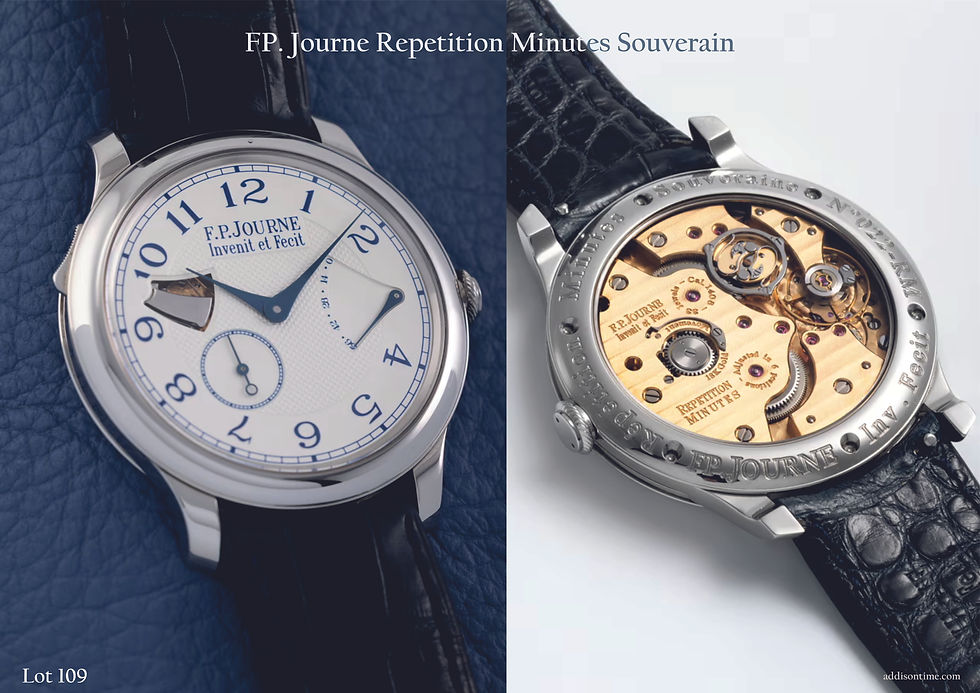
Under these conditions, independent master watchmakers face the challenge of finding ways to be unique if they want to leave a mark. Philippe Dufour focusses on using traditional tools and methods to produce a quality that the best contemporary machines cannot achieve François Paul Journe consistently succeeds in rethinking long-standing practices to improve on them significantly. For example, he is replacing different sounds with different beats in his Répétition Souveraine (lot 109) to distinguish time intervals. The watch case is the resonating body and is made of steel due to the superior amplification of the metal. Consequently, parts can be saved or minimized. On launch, the watch was the slimmest minute repeater available.
Ergonomics of the Measurement of Time
Lot 43 is pursuing a different philosophy. Harry Winston is not a name that comes to mind first when thinking of independent watchmaking. However, their ‘Opus’ line is just that. The Opus 9 in the auction was developed by master watchmaker Jean-Marc Wiederrecht and designer Eric Giroud. Objective was to reinvent how time is read. The result were two chains made of diamond baguettes and driven by the watch movement. Both chains also contain ruby baguettes that drive by hour and minute scales to communicate the current time. Design and quality of the original watch fully comply with the expectations raised by the name ‘Harry Winston’.

Heart on Sleeve
MB&F counts as established among the independents and already builds on elements ‘learned’ by its disciples. For ‚Legacy Machine Split Escapement EVO UAE Year of the 50th‘, that means the balance wheel is attached to a frame that makes it seem like it is floating above the dial. In reality, the elongated balance staff receives its impulses below the dial outside the visible range. The idea is to provide a ‘stage’ to the heart of the movement that otherwise remains outside the limelight. At the same time, the daring construction communicates superior craftsmanship, that follows the aesthetics effortlessly without compromising precision time keeping. The auction catalogue calls this ‘mechanical theatrics’.

Plus Legèr: Horlogerie - French Style
The number of Cartier lots seems to be ever increasing of late. The reason is obvious. The Brand embodies like none else the unmatched creativity of French luxury while offering a quality that is in sync with the ‚Haute Joaillerie‘ heritage of the mame. Cartiers' long history includes evergreens like the ‘Santos’, ‘Tank‘ or the ‘Coussin Tortue’ as well as designs that push the envelope further like the ‘Crash’ that has been in strong demand recently. It is not always easy to navigate and evaluate the diversity of models so that the estimates generally cover a broad range of prices. On the upside, this allows different budgets to participate in the bidding process. No fewer than 19 Cartiers are in the current catalogue. The below only summarizes some of the most interesting and valuable pieces.

For The Looks
Datejust und Day-Date are the bread-and-butter business of Rolex, so to speak. As production was always big, they offer attractive opportunities for beginners now. However, the growth expectations should match the investment. Vintage pieces with frequently seen dials are only collectible in top condition. Or it has to be rare configurations like Datejusts with their Jubilée bracelets in white gold or Day-Dates on their original oyster bracelets.
Since the late 1960’s, Rolex addressed a design and lifestyle oriented audience with the creation of exotic dials. ‘Stella’ dials in rare color shades with a high gloss finish, the producer of which gave the dials their nickname are particularly in demand. Dials made of rare materials like mother of pearl or thin stone sheets are also very sought after, as well as dials that were covered with elegantly grained wood layers. MLG’s catalogue offers a wide range of choices.

With it’s latest ‘Exclusive Timepieces’ catalogue, Davide Parmegiani and his team at Monaco Legend Group again demonstrated great vintage expertise. Their broad selection of collectible watches at different price levels additionally indicates the likable intention to address a diverse clientele with different pocket sizes. Good luck with the paddle!
Sincerely Yours,
Oliver Knop


