
Watch Auctions 2026 - Back in Business!


I created around 4.400 new millionaires was one of the comments Elon Musk made around the initial listing of his SpaceX on June 16th of this year. This was referring to his employees that he paid with shares in the company. Tech, Defense and Energy continue their rally and the party that went with it continues. While many lament high gas and coffee prices, others bemoan long waiting lists of perks from limited watches, handbags or automobiles. Musk’s new millionaires add to the 400,000 that already lived in New York City prior to his successful floatation.
Incredible Growth Without End in Sight
Considering that a mere 281 pieces of Patek Philippes quintessential wristwatch model 1518 were ever produced some 80 years ago, it becomes obvious, why the price of the even fewer examples remaining today can only go in one direction. The high-end segment is the engine behind a historic development that publicly started when Phillips in Association with Bacs and Russo broke the 40 million mark in one single sale for the first time in December of last year. 44 m US-$ including buyers premium was the total of their Park Avenue White Glove Sale prior to Christmas.
Between April and June of this year, Antiquorum, Christie’s, Monaco Legend Group (MLG), Phillips and Sotheby’s made a combined € 640 m during their live sessions in Geneva, New York, Hong Kong and Monaco. This was up € 220 m or 52% over a year ago. In this, New York dwarfed its own record behind a staggering $ 75 m.

Phillips in Association with Bacs and Russo Geneva, New York and Hong Kong Watch Auctions
Under the 10-year reign of Aurel Bacs and Livia Russo, Phillips became the clear market leader and was able to distance the runner ups further this year. The number of lots on offer only grew by a moderate 26 watches or 4%. The average price hammered climbed by astonishing 80% to mind boggling € 280.000 per lot. Does this mean you need to be able to spare a quarter million if you want to be admitted to the events? Fortunately not, because the average is driven by the high-end lots of the catalogue. Today, Phillips achieves the highest prices for the best pieces, regardless of whether vintage, contemporary or design. They are the number one address for submissions of all kinds and that is a self-accelerating dynamic.

Increasing Importance of Contemporary Haute Horlogerie
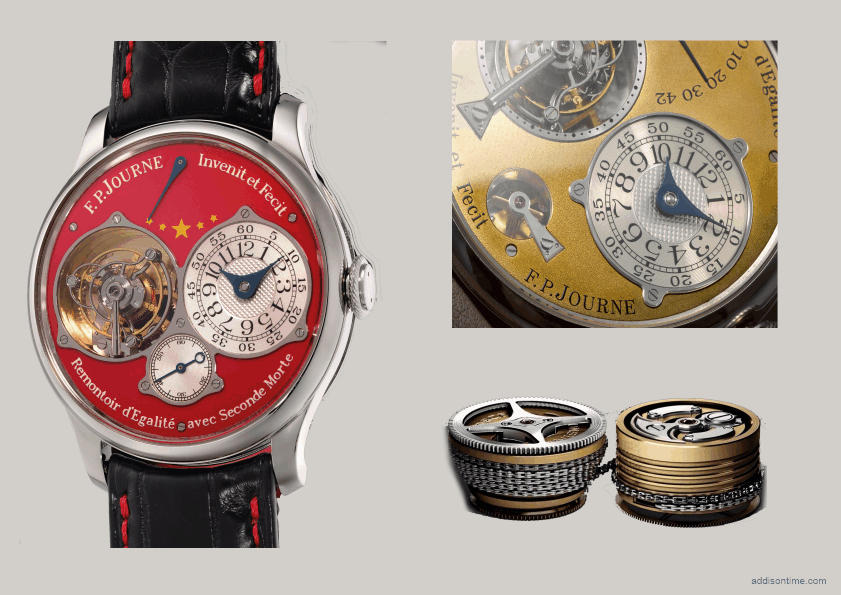
Of course, Phillips benefitted from the experience and the network that Aurel Bacs and Livia Russo built prior to joining. However, their real contribution was the strategic development of the Contemporary Haute Horlogerie, as celebrated in competitions like the annual Grand Prix d’Horlogerie from the onset. Their first catalogue in 2015 already featured 6 lots by Franҫois-Paul Journe. They achieved around a combined € 230.000 back then. The June catalogue of this year featured 17 Journe watches achieving a combined € 15 m. The lowest price for a Journe watch in the first catalogue was € 20.000, in June’s New York Watch Auction it was at € 150.000. On both occasions, the model was a Chronomètre Souverain in a platinum case. And so, it is no surprise that the current world’s record for a Journe watch was achieved by Phillips too, when a Chronomètre à Resonance of the initial series (‘Souscription’) was sold at over € 12 million.
Phillips in Association with Bacs & Russo, Spring Watch Auctions
Monaco Legend Group Auctions - Exclusive Watches Live Auctions
Six years ago, Monaco Legend Group was the newcomer among the top auctioneers of fine watches. However, the story began much earlier, at the end of the 1980’s in Milan. Davide Parmegiani or ‘The Boss’ as his ‘followers’ like to respectfully refer to him established himself as the quality leader of the Italian vintage watch market, which is quite a feat. In my view, Italians have forever been spending more money on beautiful watches than any people else on the planet. If I chase a rare watch today, I find it there or in the US. Despite his commercial success, he preserved his passion for vintage timepieces that connects him with the likeminded on both sides of the ocean. This is how he is continually able to come up with unheard of pieces that trigger the desires of even the most spoiled collectors and scholars alike.

MLG Exclusive Watches, Spring Auctions
Christie’s Rare Watches Live Auctions
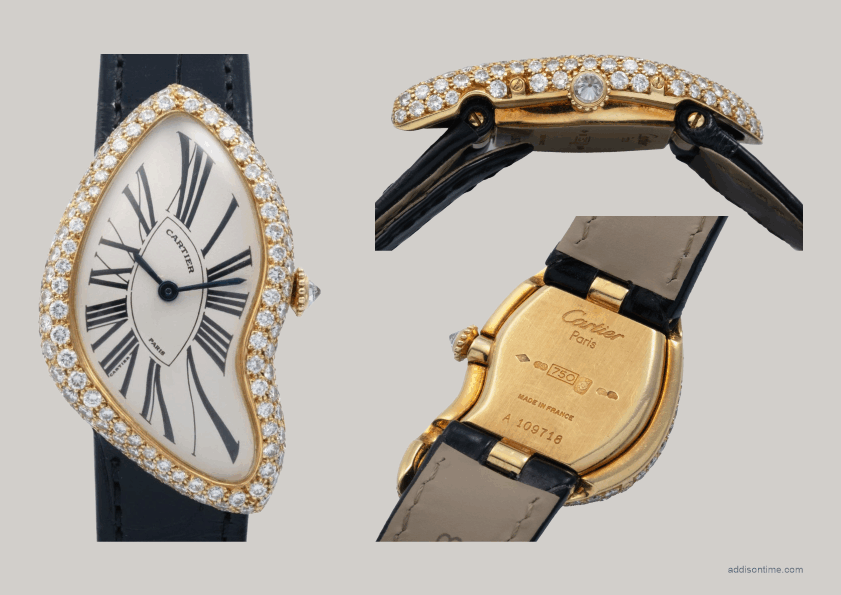
Christie’s is perhaps the premier auction house across categories and has been that for watches specifically too. The final catalogues as Aurel Bacs was still heading the department were unrivalled, thanks to the relentless focus on authenticity and quality, that Christie’s generations old client relations oblige them to. That has not changed, so that that Christie’s is still entrusted with some of the most precious pieces to this day. This season, Christie’s was the only auctioneer able to offer the ‘Cartier London’ version of the much hyped ‘Crash’ model, and at CHF 1.6 m the lucky consignor hopefully did not regret his choice of auction house.
For those in the know, an Audemars Piguet chronograph created in the 1920’s and sold in 1937 was perhaps the most exciting lot of this year so far. The watch was housed in a platinum ‘Coussin Tortue’ case and featured a Le Coultre ebauche, making it the only vintage Audemars chronograph known not to be built on a Valjoux movement.
Like Phillips too however, Christie’s is not only able to convince with rare watches of the past but they cover contemporary watches too. This is why they are able to profit from the current boom of contemporaries too and were able to sell an early Journe Tourbillon Souverain (‘T-Series’) for € 2.5 m.

Christie’s Rare Watches Spring Auctions
Sotheby’s Important Watches Live Auctions
Sotheby’s is long established as Christie’s too and was able to auction important pieces in the past as well, the most famous example of which certainly was Henry Graves ‘Super Complication’ in 2014. Even before, they came up with intriguing lots, like Konrad Adenauer’s own 18k Datejust that was accompanied by a letter of Rolex founder Hans Wilsdorf himself in which he suggests to continually wash the watch with soap in the sink to preserve its shine. I do that with mine to this day. However, after several changes in the European management, watches lost significance in the old world, which is where Swiss watches are made to begin with. A renewed aim for quality is visible today, as well as an understanding of where the market will go. The better part of sales growth to date is owed to some 82 Cartiers, offered as a themed section in the context of the Hong Kong sale in April.

Sotheby’s Important Watches, Spring Auctions
Antiquorum Important Modern & Vintage Timepieces Watch Auctions
Just as Phillips in Association with Bacs and Russo is currently taking the market to the next level, Antiquorum can claim having developed it in the first place. Under the leadership of the now famous Osvaldo Patrizzi, timepieces have flourished. Momentous sales like ‘The Art of Patek Philippe’, ‘The Art of Rolex’ or the 2006 sale of Guido Mondanis unbelievable Rolex collection certainly elevated the auction house straight into the Hall of Fame. Today, Antiquorum continues to be a point of gravity for savvy collectors and professionals thanks to the expertise of their long-standing Directors Julien Schaerer and Etienne Lemenager. The fortunate event of Parisian guru Romain Rae owning the franchise today additionally ensures, there are always important pieces in the catalogue. Antiquorum is where one can still detect hidden treasures in a catalogue that can comprise 700 lots or more.

Antiquorum Important Modern & Vintage Timepieces, Spring Auctions https://catalog.antiquorum.swiss/en/auctions/monaco_june_2026/lots
Growth Driver Independents, Contemporary Haute Horlogerie
Franҫois-Paul Journe
No one competes the establishment, consisting of the likes of Patek Philippe, Audemars Piguet or Vacheron Constantin more effectively than Franҫois-Paul Journe. He built his company with strategic foresight, new ideas quality craftsmanship in a grounded and sustainable manner. Very few other watchmakers play in the same league. Journe was influenced by the late George Daniels, who saw himself in the tradition of the great Louis Abraham Breguet. Both confirmed their ambition with important inventions. Daniels created the ‘Co-Axial’ escapement that is built into every Omega movement today and Journe was able to improve Breguets famous Tourbillon by adding a seemingly simple constant force device that made Berthouds cumbersome ‘Chain and Fusée’ mechanism as it was first deployed in A. Langes ‘Tourbillon pour le Merite’ redundant.
Philippe Dufour, Independents
Philippe Dufour contrasts against Journe by representing the traditional watchmaking craft of the ‘Paysans-Horlogers’ of the Vallée de Joux. Their main skill was the ability to miniaturize complex mechanics without impairing their precision and reliability. Dufour was first to downsize the minute repeater with grande et petite sonnerie to wearable wristwatch dimensions in 1992. He thus preempted Patek Philippe and closed the loop with the legendary workshops of the Vallée like Louis Elysée Piguet or Golay, who were the hidden champions of the great Maisons of Geneva in the 19th century.
Due to the many hours of highly specialized manual work that go into each of his watches, only very limited quantities are available. Whenever Dufour’s watches come up at auction, they are sure to sell at extraordinary prices. Even rarer are pieces by the celebrated watchmaker Rexhep Rexhepi (Akrivia) or Bernhard Lederer.

Contemporary Haute Horlogerie in Series, Richard Mille, Greubel Forsey and MB&F
Producing high-end timepieces in series of common specifications like Journe is only achieved by few other watchmakers. Among them are Greubel Forsey with their Tourbillons or MB&F with their Legacy Machines. Apart from watchmaking, it requires an aesthetically pleasing and recognizable design language that references the uniqueness of the Brand. Daniel Roth was aware of this when he developed the design of complicated Breguet wristwatches that is still in use today and he did it again, when he developed the unique cases, crowns, dials and hands of the watches he later produced under his own name. This is what sets Richard Mille apart today too. Their watches resemble high performance engines in post modern Tonneau bodies. The concept is visible in every detail and often executed with high tech materials that require cutting edge processes to be used in watchmaking. Richard Mille is addressing a very special clientele that is ready to pay immense sums to own one of these fascinating timepieces.

The Top Sells Best
Patek Philippe Chronographs with Perpetual Calendar
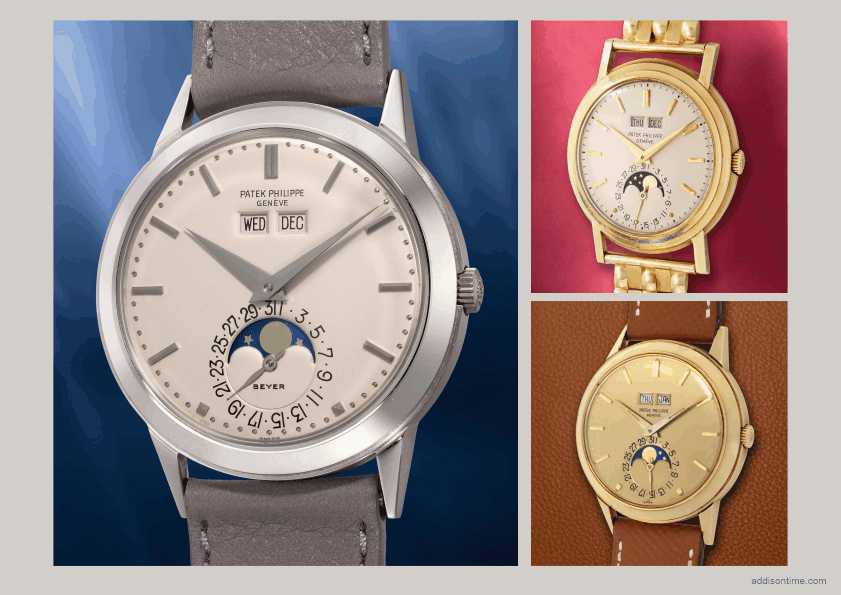
Not just the Contemporary Haute Horlogerie is driving the value growth of the market. Important vintage models have gone up in too. A good example are Patek Philippes perpetual calendars of the 1940-80’s, with or without chronograph. Models with chronograph were produced in two generations on the basis of Valjoux ebauches and calendar modules by Victorin Piguet. The first generation began in 1941 with the model 1518 and the second started in the beginning of the 1950’s with model 2499. The steel version of reference 1518 is probably the most valuable vintage wristwatch today but the version in rosegold is aesthetically superior and very rare too. Only around 50 of model 1518 were produced. The case maker of model 2499 was changed after the first batch so that only 5 to 10 rosegold examples of the initial 2499 series are believed to exist at all. Naturally, if one pops up that was not known before, in good condition with a believable history, it is sure to attract the attention of the most potent bidders.

Patek Philippe Perpetual Calendar without Chronograph
Perpetual calendars without chronograph were originally launched alongside the chronograph versions, based on Pateks own manually wound calibers and from the early sixties, Patek was first to offer perpetual calendars with automatic winding. The first self-wining movement 12-600 AT by Patek appeared in the mid-fifties in model 2526 but it was replaced only a few years later. The succeeding caliber 27-460 was improved at the rotor bearings and formed the basis for the automatic perpetual calendar 3448 introduced in 1961. Still, a manually wound alternative was produced in 3 examples too and received its own reference number 3449.
The automatic version is especially sought after, if the case is made of white gold and the yellow gold version if it has a so-called Doré dial. Patek Philippes rarely come with golden dials so that the few that do exist are sought after collector’s trophies.
Rolex ‘Paul Newman’ in Gold - Quality Matters
The more examples of a valuable vintage model exist, the more important their condition becomes. About three to five thousand Daytonas with ‘Paul Newman’ dials are believed to exist. Assuming, 5 to 10% of those were made of gold make 150 to 300 watches. Examples continually come up at auctions and their prices vary significantly depending on the shape they are in. Golden watch cases are vulnerable to wear and rarely improve during servicing. Original hands, crowns and bezels are often replaced. The all important part however, is the dial itself. In the below visual, three different dials can be seen. The upper dial to the left is in a very good shape, but the watch, it belongs to is worn. The dial at the bottom shows some commonly seen flaws. Its luminous dots were replaced and the counters show traces of the tools that were used to remove them. Additionally, there is abrasion to the outer track from taking it on and off the watch. This will worsen with time, as the now unsealed substrate will begin to oxidize. The complete watch on the right is in near perfect condition. Prudent collectors seek professional advice before they spend 6 digits on a watch and that explains the difference in the hammer price between the three examples.

Cartier
Among the most popular Brands, Cartier takes a special place. That is because of the long history, beginning with the Santos over a hundred years ago, that makes them believable as wrist watches. However, the true roots of Cartier are in Haute Joaillerie. In both areas, Cartier has set benchmarks over the years. Beyond the Santos, there are Tanks, Baignoires, Tortues and others. In jewelry, there are there are the Trinity, Clash or LOVE collections and the Panthère style is used for watches and jewelry alike. French avantgarde designs, delivered in perfect quality for over a century created a lasting heritage for the maker. Today, the most sought-after designs are those that were created by the London branch in the 1960 to early 70’s. The most famous one is the ‘Crash’ but the others are catching up of late.

Haute Horlogerie und Haute Joaillerie
Cartiers upswing is spart of a wider trend toward watches in Haute Joaillerie designer cases, hence proving the fact, that it is no longer just men that like classical timepieces. Enthusiasts are seeking iconic designs of the past that have become rare sights today. The makers are mostly the high-end watch Brands or Maisons that are esteemed for their Haute Joaillerie collections, like Van Cleef, Bulgari or Piaget.
Magischer King Midas
The Rolex King Midas from 1961 is a good example, how an extraordinary style for its time, perfect quality and the generous use of precious metal combine into an increasingly sought-after vintage designer watch. The case of the watch is very flat, and yet it has a screw down case back. This is possible because inside ticks the flattest movement at the time, delivered by Blancpain. The links of the integrated brace are as thick as the case itself and were crafted from solid blocs of gold. At the time of its introduction, the King Midas was the heaviest golden Swiss watch on the market and the most expensive one in the Rolex catalogue. The design of the watch is commonly attributed to Gerald Genta, who went on to create the Royal Oak and the Nautilus in the 1970’s.

Serpenti, Bulgari’s Snake Watch from the 1960’s
The importance of the image seems to become clear when comparing two Bulgari Serpentis that came up at MLG and at Antiquorum this spring. The MLG watch had an Omega movement built into it and was signed Omega and Bulgari to the dial. The Antiquorum watch featured a Jaeger Le Coultre caliber and came with it#s original presentation case. Otherwise the watches were similar. The MLG watch went for around 120.000 Swiss Francs, while Antiquorums example achieved over 255.000 Euros. It is interesting to observe that Omega seems to have been a suitable Brand for such a watch in the 1960’s while today it is hard to imagine buying an Haute Joaillerie watch signed Omega.

What’s Next?
It will be exiting to observe if the dynamic growth of the spring will continue this fall. The previews of MLG and Phillips have started this week and Phillips has already announced the sale of another rare FP Journe Chronomètre à Résonance, the first example with a commercial serial number. I will say 'goodbye' for now to enjoy the Labor Day weekend in La La Land. I will be back with the most interesting lots of the upcoming season.
Happy Summer End,
Oliver Knop


